
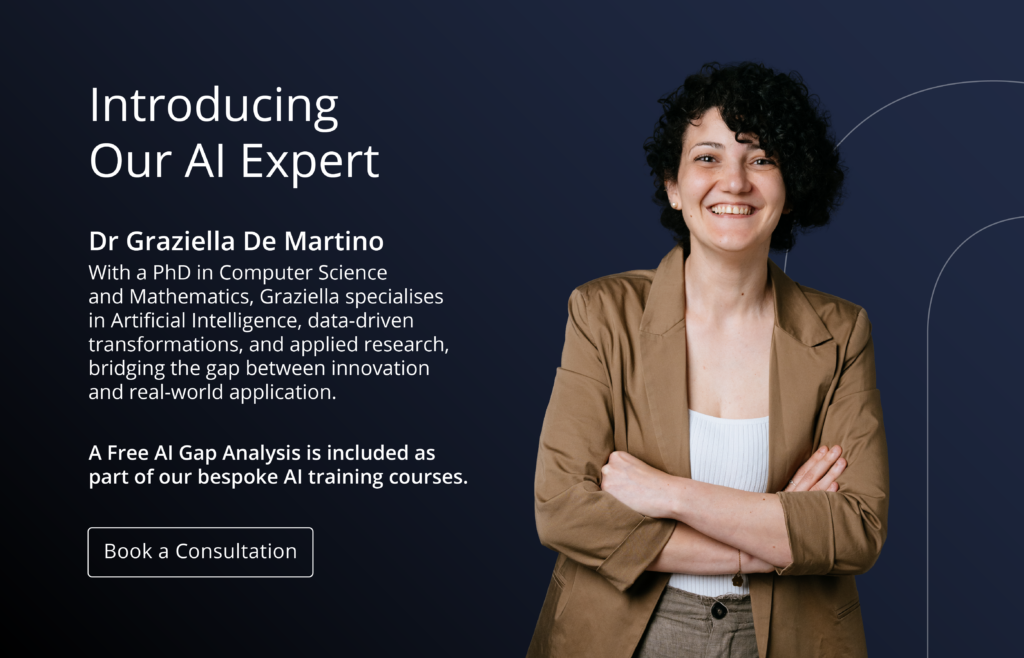
AI Expert Insight by Dr Graziella De Martino
Of the four dimensions a serious AI readiness assessment examines, three tend to produce findings that leadership teams instinctively know how to respond to. A process gap feels solvable; a data governance gap feels addressable; an infrastructure gap feels like a procurement conversation waiting to be scheduled. It is the fourth dimension, human capacity, and the governance structures built around it, where the distance between perception and reality tends to be widest, and where the instinct to respond quickly is most likely to produce the wrong answer.
The issue is not simply whether employees have attended AI training. It is whether they have been given the contextual support to use that knowledge productively in their specific roles, working alongside the specific systems their organisation is moving toward. We ask questions in our assessments that many organisations have never formally posed internally: which roles are already interacting with AI systems, even peripherally; who has the authority to approve or reject AI-assisted outputs; and when an AI system produces an error, is there a clearly identified human accountable for catching it? The answers, when they come, are usually hesitant; not because the organisation lacks capable people, but because the structures that would direct that capability have not yet been built, and in many cases have not yet been seriously contemplated. The latter is where the hidden risks begin to compound.
The informal AI adoption uncovered during the process review, specifically employees using unapproved tools quietly and often cleverly, does not disappear when the organisation formalises its AI strategy. It goes underground, or it scales. Either outcome is more dangerous than the original behaviour, because it now exists in the shadow of a governance framework that was not designed to account for it. The gap between what the policy says and what people actually do tends to widen in direct proportion to the pressure employees are under and the little practical guidance they have received. A policy issued without the training to support it is not governance; it is documentation of an intention that nobody has been equipped to honour.
There is a deeper discomfort here that surfaces in almost every assessment, and it is worth naming directly. When the findings reveal a governance vacuum around who is actually responsible for AI decisions and their consequences, they are not describing a technical problem. They are describing a leadership problem; one that infrastructure spending alone cannot resolve and that general awareness training cannot substitute for. The organisations that recognise this distinction early are the ones that build AI capability with some durability, while those who treat human readiness as an afterthought tend to find themselves revisiting the same gaps at increasing cost.
What the EU AI Act reinforces is that these four dimensions are not independent workstreams to be assigned to separate teams and reviewed at separate intervals. A future state in which AI is meaningfully embedded into operations requires all four to move together: processes that are documented and designed for AI integration, data that is governed and properly understood,
infrastructure that can carry the operational load, and people equipped not merely with general AI literacy but with context-specific judgment about the systems they work alongside. The gap analysis does not produce a list of fixes but produces a map of relationships between things that all need to move in the same direction, and at a pace the organisation can actually sustain.
NOUV offers a complimentary AI maturity gap analysis as a starting point for leadership teams ready to take this work seriously, as a genuine investment in understanding rather than a sales exercise. Organisations that identify material gaps and commit to addressing them through bespoke, context-specific training can also offset part of that cost through the Investing in Skills scheme administered by JobsPlus (https://jobsplus.gov.mt/funding-employer/investing-in-skills).
The more pressing reason to act, however, is not us. The organisations that understand their current state now will be the ones making deliberate choices about what comes next. The ones that wait will find themselves explaining their gaps not to a consultant but to a regulator, and that is a significantly more expensive conversation; one that, unlike this one, will not be offered for free.
SIMILAR POSTS

What We Find When We Actually Look
AI Expert Insight by Dr Graziella De Martino There is a particular kind of silence that settles over a leadership……
7 April 2026 • 6 months ago

Business Resilience
As sure as the sun will rise, businesses will continue to face continuous turbulence. Higher volatility has become the new normal, and an uncertain business context is a part……
15 July 2024 • 2 years ago

Exciting Updates to the Get Qualified Scheme!
We’re thrilled to share some great news that will enhance your experience with the Get Qualified initiative! NOUV Academy is happy……
8 April 2026 • 6 months ago

Applied AI with Integrity: Meeting the Demands of the AI Act
The EU’s AI Act is redefining how businesses approach AI. Discover how applied AI, when guided by integrity and compliance,…
12 November 2025 • 11 months ago