
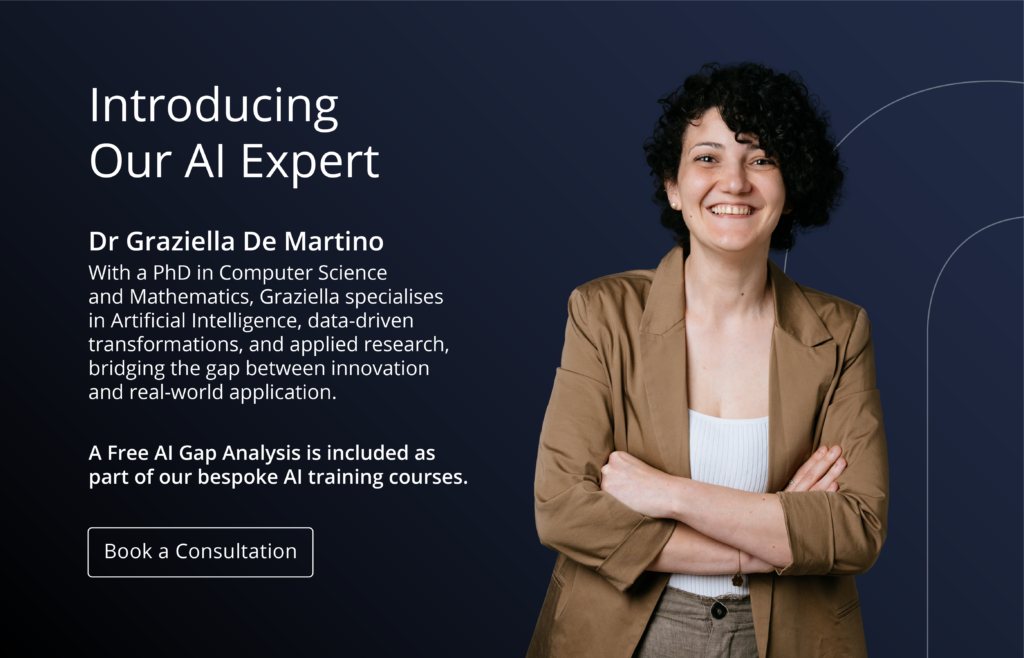
AI Expert Insight by Dr Graziella De Martino
I have witnessed a familiar scene countless times: a leadership team gathers around a table. Someone provides an update on the organisation’s AI progress, another mentions a training programme held last autumn, and a third nods toward a new tool the IT team integrated in the last quarter. There is a shared sense of forward movement, but then a quieter question surfaces, usually from the person who has been listening more than speaking: do we actually know what it is doing?
At that moment, the atmosphere shifts. It is not that the question is unreasonable; it is simply that the honest answer is almost always no. Most organisations are not genuinely implementing AI; they are creating the illusion of it. And when that distinction eventually becomes visible, it is usually expensive.
This observation is not intended as a criticism of those involved. The pressure to appear AI-capable has become nearly unbearable. Boards are asking questions, competitors seem to be advancing, and media headlines create a feeling that any delay carries its own risks. Organisations respond with subscriptions, training budgets, and public announcements. Activity becomes a stand-in for progress, even though genuine progress is harder to measure and considerably harder to explain.
What often gets overlooked is the question that should come first. Not which AI tools to use, but where are we right now? What workflows actually exist, not as they are described in documentation, but as they function in practice? What data does the organisation hold, and how well does it understand it? Where are AI systems already shaping decisions without formal approval? Where are governance gaps quietly accumulating out of sight?
The organisations that struggle most are not those that took a slow, measured approach. They are the ones that rushed to act on unstable foundations. They purchased software, trained staff, and then discovered there was no meaningful connectivity between the tools, the business outcomes, or the increasingly stringent regulatory environment that had evolved while they were looking elsewhere.
The EU AI Act clarifies something that has long been shrouded in ambiguity. Article 4 mandates that employees possess sufficient AI literacy, defined as skills and understanding tailored to their technical context and the specific AI systems they work with. A generic online course, regardless of its quality, is unlikely to meet that threshold. The emphasis is not on certificates but on whether employees can make informed decisions about the AI they use. These two things are fundamentally different.
The broader AI market is commercially incentivised to skip diagnosis and jump straight to solutions. Tools, training, and platforms are far easier to sell than clarity, so organisations routinely invest in answers before they have fully understood the question. However, clarity is achieved through a systematic and truthful assessment rather than by accumulating additional resources. The honest route may be slower than signing up for a subscription and considerably less thrilling than announcing a new capability. Yet it is the only type of work that holds firm when tougher questions arise.
The most honest thing a leadership team can do right now is resist the pull toward performance. Not the performance of their AI systems, but the performance of having AI at all. The subscriptions, the training certificates, the announcements: none of it is inherently wrong, but none of it is inherently enough either. Momentum that is not anchored to genuine understanding has a
way of compounding quietly until the cost of correction becomes far greater than the cost of pausing would ever have been.
The organisations that will navigate this well are not necessarily the ones moving fastest. They are the ones willing to ask uncomfortable questions before committing to expensive answers. They are the ones treating AI readiness as a diagnostic exercise, not a procurement one.
SIMILAR POSTS

The Importance of Human Capital Management
What do you think is the most valuable resource in an organisation? Well, the answer is employees. These are the individuals that spend the……
15 July 2024 • 2 years ago

How to Open a Company in Malta: Step-by-Step Guide for 2025
Malta is one of Europe’s most attractive hubs for new companies. This 2025 guide shows you each step, from choosing…
7 October 2025 • 6 months ago

Why PCI DSS Compliance Matters More Than Ever in 2025
Payment security isn’t just an IT issue; it’s a business imperative. With cybercrime targeting payment systems at record levels, and……
11 September 2025 • 7 months ago

Understanding Company Taxation in Malta: What New Business Owners Need to Know
This practical guide breaks down Malta’s corporate tax system, including tax refunds, participation exemptions, and compliance obligations for local and…
4 February 2026 • 2 months ago