
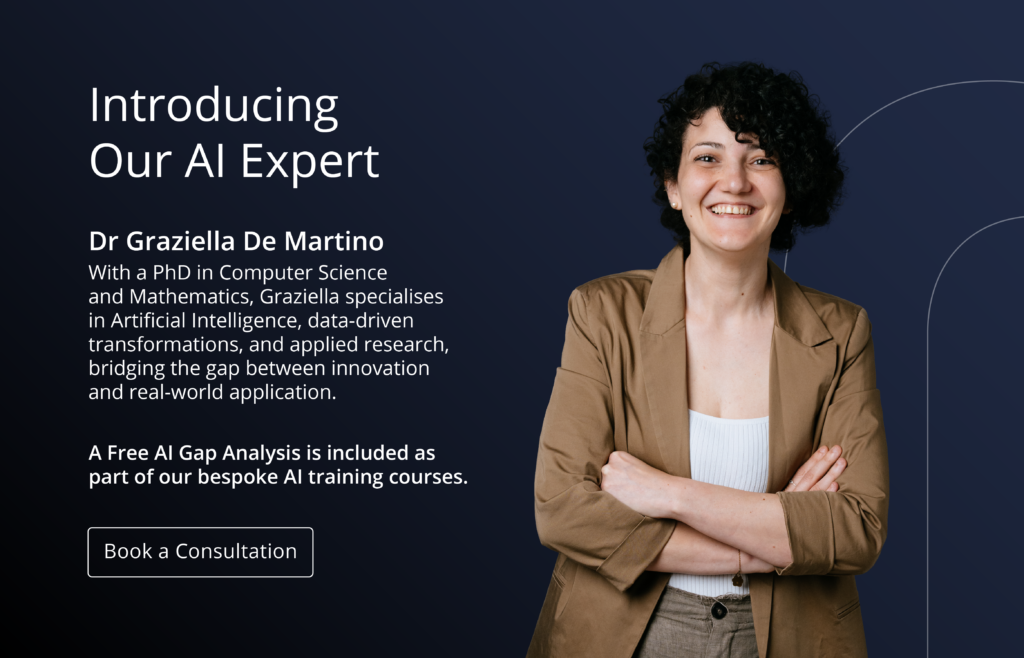
AI Expert Insight by Dr Graziella De Martino
There is a particular kind of silence that settles over a leadership team when a gap analysis begins in earnest. It is not the silence of disengagement, but the silence of people who are beginning to sense that the picture about to emerge may not resemble the one they have been carrying. That instinct, more often than not, is correct.
Most leaders approach the gap analysis with a quiet assumption already in place. They believe the exercise will confirm that their organisation is roughly 70 percent of the way there, that a few targeted interventions will close the distance, and that they will emerge with a tidy roadmap. That is rarely what happens. What the assessment usually reveals instead is that the organisation does not yet have a stable enough picture of its current state to define what a credible future state should even look like. You cannot map the distance between two points if one of them keeps moving.
The work begins, as it must, with processes; not as they appear in procedure documents or onboarding materials, but as they actually function on a Tuesday afternoon when a deadline is approaching, and shortcuts are being quietly taken. When we examine workflows closely, we typically find three things happening simultaneously. There are formal processes that exist on paper but have been partially or entirely abandoned in practice. There are informal processes that have evolved organically, often intelligently, but which no one has documented or evaluated for AI compatibility. And then, most significantly, there are already AI-adjacent tools embedded in those informal processes, introduced by individual employees acting without organisational approval, guidance, or awareness. The as-is state, in other words, is not what anyone thought it was, and in most cases, it has not been what anyone thought it was for quite some time.
Data environments produce their own category of revelation. Organisations frequently overestimate the accessibility and integrity of their data; not out of dishonesty, but because the people who commission assessments are rarely the people who manage data in practice. What often emerges on closer examination is an environment of fragmented repositories, inconsistent taxonomies, and undocumented ownership. There are also data flows that have never been formally mapped, particularly those involving third-party platforms quietly processing sensitive information under terms that few inside the organisation have read in full. When the future state involves AI systems making decisions based on that data, these gaps cease to be abstract concerns. They become direct liabilities, regardless of whether the organisation intended to create them.
Infrastructure presents a different kind of challenge. Organisations often enter this conversation with optimism, pointing to recent cloud migrations or modernisation programmes as evidence of readiness. What the assessment frequently uncovers is a more complicated picture: legacy systems beneath the modernised surface layer, integration architectures not designed for the data
volumes AI workflows require, and security configurations that lag significantly behind what the regulatory environment now demands. The visible infrastructure and the actual infrastructure are rarely the same thing, and the distance between them tends to grow in proportion to how long the organisation has been avoiding the question.
These three dimensions, namely processes, data, and infrastructure, are where most of the technical findings accumulate, and together they are usually enough to give a leadership team pause. Yet they are not where the assessment becomes most uncomfortable. That happens when the work turns to people; to the question of whether the organisation has not only the capability but the structures, the accountability, and the shared understanding to actually govern what it is building. That is the subject of the next article, and it is where the harder questions tend to live.
SIMILAR POSTS

How to Open a Company in Malta: Step-by-Step Guide for 2025
Malta is one of Europe’s most attractive hubs for new companies. This 2025 guide shows you each step, from choosing…
7 October 2025 • 6 months ago

Why ISO/IEC 27001 Is No Longer Optional for Modern Businesses
In today’s digital-first world, data is not just an asset — it’s a responsibility. With cyberattacks on the rise and……
7 July 2025 • 9 months ago

ISO 14001:2015 Internal Auditor Course – CQI & IRCA Accredited Environmental Audit Training in Malta
Looking to strengthen your role in environmental compliance and sustainability? Our ISO 14001:2015 Internal Auditor Course provides the knowledge and……
12 August 2025 • 8 months ago

ISO-Ready: How Management Systems Future-Proof Your Business
In today’s fast-changing world, regulatory pressure, resource constraints, and stakeholder expectations are converging. Businesses are increasingly expected not only to……
25 July 2025 • 9 months ago