
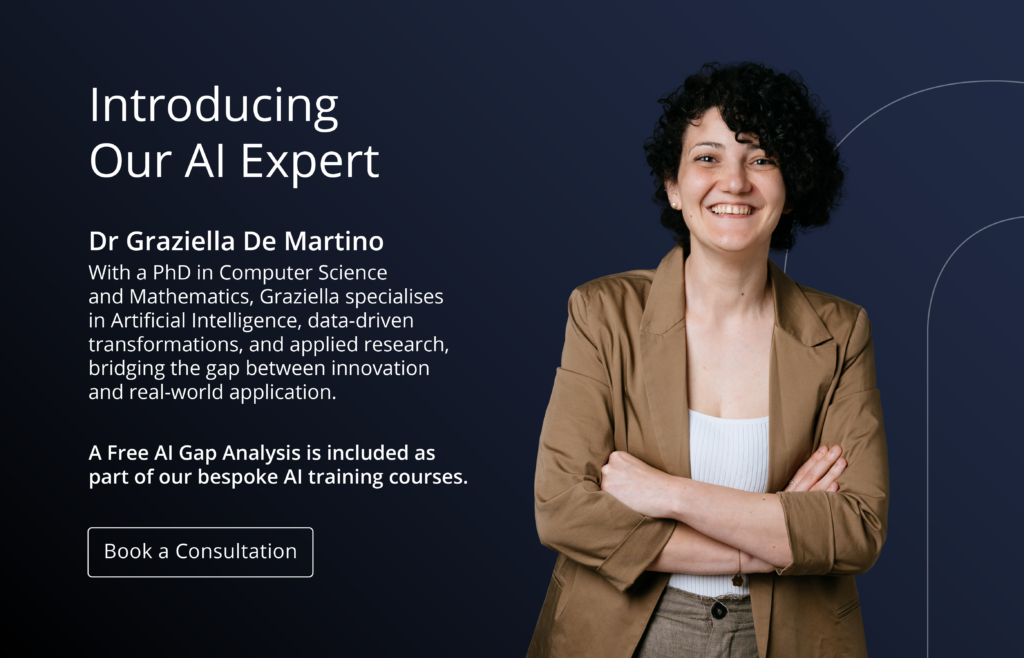
AI Expert Insight by Dr Graziella De Martino
There is a subtle but crucial distinction that is frequently overlooked in conversations about AI preparedness, and even more frequently avoided by those with a commercial interest in staying quiet about it.
Generic AI training is not a flawed product. For an individual professional building fluency, navigating a career transition, or seeking clarity about a technology that is reshaping modern work, it is often exactly what is needed. It builds conceptual understanding. It reduces uncertainty. It expands opportunity. We offer it through NOUV Academy and stand behind its value without reservation.
But here is the part that tends to go unsaid: an organisation is not simply a collection of individuals. What proves effective for someone investing in personal development often fails when applied to an organisation striving to transform its operations. Sending your team to an AI training course is not an organisational strategy; it is an individual growth initiative applied to a collective challenge. The two are not the same, and conflating them can cost businesses dearly.
We learned this uncomfortable lesson through our own experience. For a time, we offered group AI training programmes to B2B clients. The sessions were well structured, participants were engaged, and satisfaction ratings were high. By conventional measures, it looked like success. But when we shifted our attention from satisfaction to outcomes, the picture changed entirely.
Participants returned to unchanged workflows, unresolved questions, and no clearer sense of AI’s role in their responsibilities. Individuals had gained knowledge. The organisation had not changed, because no one had mapped the context the training was supposed to connect to. Workflows had not been examined. Data environments had not been assessed. Governance gaps had not been identified. The places where AI was already influencing decisions had not been formally acknowledged. Participants had been given answers to questions that had not yet been adequately asked within their organisation.
The problem was not the quality of the training. The problem was the assumption that the core issue was a knowledge gap rather than a readiness gap.
As a result, we revised our approach entirely for B2B work. We now begin with a comprehensive gap analysis, offered at no cost, before any conversation about training. This is not a marketing gateway; it is a deliberate correction. If organisations invest in knowledge without clarity about what that knowledge is supposed to achieve, the investment will rarely translate into capability.
The difference in outcomes has been meaningful. When training is grounded in a genuine understanding of an organisation’s current state, engagement increases significantly. Participants ask concrete questions. They connect what they are learning to real scenarios they recognise. Behaviour shifts, not just understanding.
The EU AI Act reinforces this distinction directly. The regulation requires AI literacy measures that are proportionate and context-specific, aligned to the organisation’s technical environment
and the actual AI systems in use. It does not ask whether employees understand AI in general. It asks whether they can make sound decisions about the AI tools embedded in their own workflows.
This article may read like a sales pitch dressed as transparency, but that is not its intention. The distinction between individual learning and organisational capability is one that many providers deliberately sidestep, because the former is easier to package, price, and deliver. It has a defined duration, a defined curriculum, and a certificate to mark the end. Building organisational capability is slower, more demanding, and requires asking questions that sometimes make clients uncomfortable. A reluctance to ask those questions is not caution. It is a disservice. And the quiet financial losses accumulating across B2B AI investments are, in large part, the cost of that silence.
In the next article, we explore what we typically uncover when we begin assessing an organisation’s actual foundation, because the findings rarely match what leaders expect.
SIMILAR POSTS

Stop Performing AI. Start Understanding It.
AI Expert Insight by Dr Graziella De Martino I have witnessed a familiar scene countless times: a leadership team gathers around a table.……
26 March 2026 • 7 months ago
Career-Driven Training Courses, Learn from Industry Experts in Żebbuġ, Malta
At NOUV Academy, we regularly host a selection of specialised training programmes designed to help professionals level up in their……
14 July 2025 • 1 year ago

AI Literacy Essentials: A Beginner’s Guide to AI for Leaders & Teams
Artificial Intelligence is no longer just a tech buzzword, it’s a part of everyday decision-making, communication, and operations. Whether you’re……
18 August 2025 • 1 year ago

Tax Compliance
Family businesses are historically one of the main pillars supporting the Country’s economy. These businesses are undergoing a period of……
15 July 2024 • 2 years ago