
ISO 14001 is moving into its next revision cycle, with ISO 14001:2026 expected to replace ISO 14001:2015. While the standard is still under development, the Draft International Standard already provides a clear view of the direction of change and what organisations should begin preparing for.
For organisations in Malta certified to ISO 14001:2015, the revision introduces moderate but impactful updates. The Annex SL structure remains in place, supporting continued alignment with other management system standards such as ISO 9001 and ISO 45001. The focus is on clearer requirements, stronger traceability and accountability, and increased attention to environmental conditions like climate change, pollution, biodiversity, and sustainable resource use.
ISO 14001:2026 Transition Timeline
Based on current information from international standardisation bodies, the anticipated timeline is as follows:
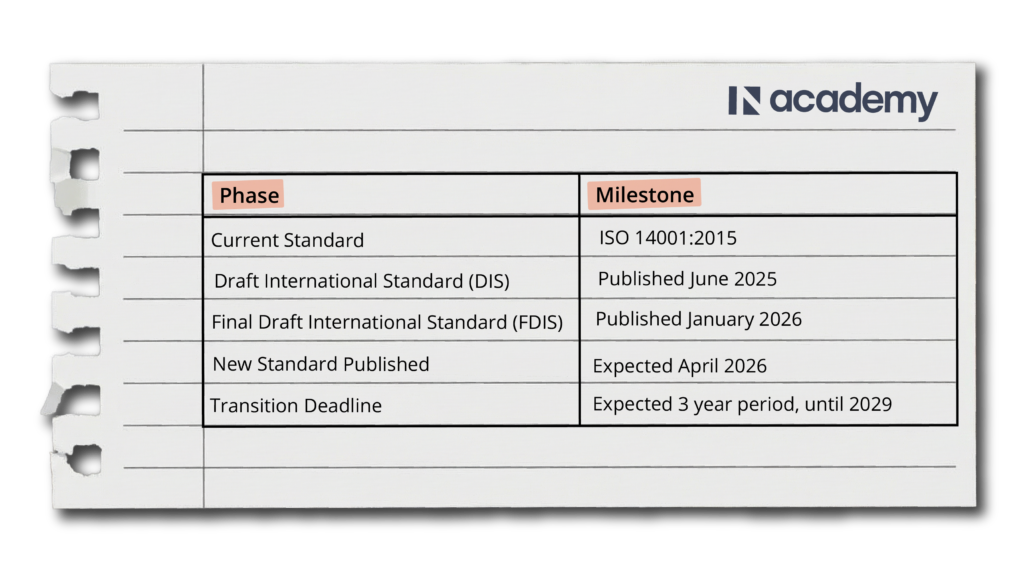
Organisations are encouraged to begin planning early to reduce disruption and maintain certification readiness.
Anticipated Changes in ISO 14001:2026
While no entirely new requirements are expected, multiple clauses are revised to improve clarity, traceability, and accountability.
Clause 4 Context of the Organisation
Environmental conditions, including climate change, pollution, and biodiversity, are expected to be explicitly considered. The EMS scope is expected to reflect a life cycle approach, and key documents must be available as documented information.
Action to consider: update context analysis, stakeholder maps, and scope definition.
Clause 5 Leadership and Commitment
Terminology is updated, with “meet compliance obligations” replacing “fulfil”. Greater emphasis is placed on conserving natural resources and protecting ecosystems.
Action to consider: revise your environmental policy and ensure executive engagement.
Clause 6 Planning
A new Clause 6.3 introduces a structured approach to EMS related change management. Emergency situations are separated from abnormal operations. Planning is split into clearer sub clauses, with 6.1.4 focused on identifying risks and opportunities and 6.1.5 focused on planning actions accordingly.
Action to consider: refresh risk registers, aspect impact evaluations, and planning documentation.
Clause 7 Support
Terminology is now standardised, with EMS records required to be “available as documented information”. Communication expectations place stronger emphasis on empowering employees to contribute to continual improvement.
Action to consider: review communication and training processes.
Clause 8 Operations
“Outsourced processes” are reframed as “externally provided processes, products or services”. Operational control is expected to extend to suppliers and partners. Emergency preparedness must align with risk planning (Clause 6.1.2).
Action to consider: strengthen supplier management and emergency planning.
Clause 9 Performance Evaluation
Explicit requirement to evaluate environmental performance and EMS effectiveness. Internal audits must define objectives, in addition to scope and criteria. Management reviews are restructured into three sub clauses covering inputs, process, and results.
Action to consider: update internal audit and management review processes.
Clause 10 Improvement
Clause 10.1 is removed, with content integrated into Clauses 10.2 and 10.3. A more structured approach is expected for nonconformity and corrective action, with clearer linkage between Clause 9 findings and continual improvement.
Action to consider: strengthen root cause analysis and improvement tracking.
What Organisations Should Do To Prepare For ISO 14001:2026
Even before ISO 14001:2026 is officially published, organisations can take practical steps:
- Conduct a gap analysis against the Draft International Standard
- Update EMS documentation to reflect revised clause references and terminology
- Train staff on updated responsibilities and language
- Prepare for structured change management expectations under Clause 6.3
- Reinforce supplier controls and life cycle considerations
- Engage top leadership early in the transition process
Early preparation reduces pressure during the transition period and supports smoother audits.
Why the ISO 14001:2026 Transition Matters
The revision reflects growing expectations around sustainable development, climate resilience, and environmental accountability. For organisations in Malta, this transition is also an opportunity to strengthen governance around environmental performance, improve stakeholder confidence, and support wider ESG priorities through a more robust Environmental Management System.
How NOUV Academy Supports ISO 14001 Transitions
NOUV Academy supports organisations in Malta by strengthening existing ISO 14001:2015 knowledge and audit capability in preparation for the upcoming transition. While ISO 14001:2026 specific transition courses will be introduced once the standard is formally released, organisations can already prepare through our ISO 14001:2015 Foundation – IRCA Accredited, ISO 14001:2015 Lead Auditor – IRCA Accredited, and ISO 14001:2015 Internal Auditor – IRCA Accredited courses.
These courses help professionals understand the structure, intent, and application of ISO 14001 requirements, creating a strong foundation for future transition efforts. Training can be delivered online, in classroom settings at NOUV Academy in Zebbug, or through bespoke in house sessions tailored to organisational needs. Where applicable, organisations can also request guidance on refund schemes and funding routes available in Malta.
To explore ISO training and transition support, visit https://nouv.com/academy/
For tailored support, contact the Academy team at training@nouv.com
Disclaimer: This article is based on publicly available information regarding anticipated ISO 14001:2026 changes. Final requirements may change following publication of the official ISO 14001:2026 release.
SIMILAR POSTS

An All-Encompassing Mindset
James Sammut, Partner & Chief Sustainability Officer at NOUV Winter is meant to be the season of coats, keeping warm……
15 July 2024 • 2 years ago

The Knowledge Academy x NOUV Academy – Global Certifications in Malta
Through our ongoing partnership with The Knowledge Academy, NOUV Academy offers access to one of the world’s largest selections of……
30 June 2025 • 1 year ago

Any company can embrace ESG principles
‘Many think that ESG practices concern exclusively large companies. ESG implies sustainable practices and sustainability is good for any business,’……
15 July 2024 • 2 years ago

Something Phishy: How to prevent phishing attacks
Despite improvements in technical security measures, phishing remains one of the easiest and cheapest means for criminals to steal sensitive……
15 July 2024 • 2 years ago